
You have probably had a colonoscopy recommended, or perhaps an upper endoscopy. What about the stretch of digestive tract in between – the small intestine – that stretches nearly six metres and sits largely out of reach of conventional scopes? That’s where capsule endoscopy comes in.
If you have been dealing with persistent abdominal pain, unexplained bleeding, or recurring digestive discomfort and have not found answers yet, consulting the best gastroenterologist you can find might lead you straight to this procedure. It’s less intimidating than it sounds, and it often reveals what everything else misses.
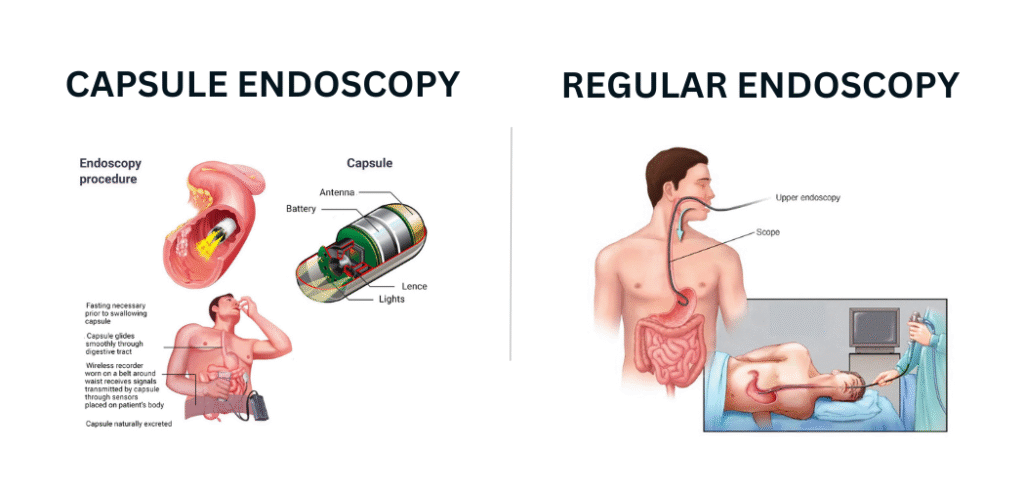
Capsule endoscopy is a diagnostic procedure in which you swallow a small capsule — roughly the size of a large vitamin tablet — containing a tiny camera, a light source, and a radio transmitter. Once swallowed, the capsule travels naturally through your digestive tract, from the oesophagus down to the small intestine, capturing around 10,000 photographs along the way. These images are transmitted wirelessly to a small receiver worn around your waist.
The whole process takes about eight hours, after which the capsule passes out of your body through stool.
Before the procedure, your doctor will administer laxatives to clear the digestive system of food debris. So the camera can capture clear images. There’s no sedation involved. You simply swallow the capsule and go about a modified version of your day while it does its work inside.
This is where capsule endoscopy earns its reputation. It’s particularly effective at identifying problems in the small intestine that standard endoscopy and colonoscopy simply cannot reach. Conditions it can help diagnose include:
Symptoms that might prompt a referral to the best gastroenterologist for this test include abdominal cramping, blood in the stool, persistent diarrhoea, chronic fatigue linked to unexplained anaemia, or significant unintended weight loss.
Capsule endoscopy is recommended for a fairly specific group of patients — those for whom conventional diagnostic methods have been inconclusive or insufficient.
One thing worth knowing: if you have a history of narrowing or blockages in the intestine, your doctor will want to discuss this before proceeding. There’s a small chance the capsule could get lodged, so your gastroenterologist will review your history and decide whether the procedure is right for you.
The most obvious difference is comfort. There’s no scope insertion, no sedation, and no recovery time needed afterwards. You swallow a pill and carry on. That said, capsule endoscopy does have limitations worth understanding:
These are procedural realities, not reasons to avoid it. In many cases, capsule endoscopy remains the most practical and informative way to evaluate the small bowel — and that makes it invaluable.
At LivGastro, every capsule endoscopy is overseen by Dr. Vijay Kumar Rai — a gastroenterologist recognised by both the American College of Gastroenterology and the American Society of GI Endoscopy.
That’s not just a line on a CV — it means the person overseeing your diagnosis is trained to international standards. We use equipment sourced from Germany, Japan, and America, and every test is carried out by qualified doctors, not left to junior staff.
If you’ve been looking up “acidity doctor near me” or trying to find a gastroenterology hospital in Kolkata where you can actually trust who’s doing your tests, LivGastro is worth a visit. All diagnostic procedures at LivGastro are conducted by highly trained doctors under Dr. Rai’s supervision, and results are delivered promptly so your care can move forward without delay.
We provide complete day care gastro and liver services — consultation, diagnostics, pharmacy, and nutrition — all under one roof.
Reach us at +91 9147105221 or WhatsApp 9369120028 to book your appointment. We are available Monday to Saturday, 8 am to 10 pm.
The procedure itself is painless. You swallow the capsule like any tablet, wear a belt-mounted receiver, and go about your day. There’s no sedation, no scope insertion, and no discomfort during the eight-hour imaging window.
Your doctor will typically ask you to fast for a period beforehand and may prescribe laxatives to clear the digestive tract. Specific preparation instructions will be given at your consultation, as they can vary based on your condition.
The capsule passes naturally through stool and does not need to be retrieved. It can simply be flushed away.
The two procedures serve different purposes. Capsule endoscopy is primarily designed to examine the small intestine, an area a colonoscope cannot fully reach. Your gastroenterologist will advise which procedure – or combination – is right for your symptoms.
The capsule captures around 10,000 images over eight hours, which your doctor reviews carefully. At LivGastro, a gastroenterology hospital in Kolkata, where every test is carried out under qualified supervision, you will get your results promptly so your care can move forward.
Fatty Liver, as the name suggests, is the excessive build-up of fat in a liver of about
read more
With the wrong diet, no medicine can help. With the right diet, no medicine is necessary
read more
You have probably had a colonoscopy recommended, or perhaps an upper endoscopy. What abo
read more