Gut Health After 50: Advice from a Gastroenterology Specialist - LivGastro LivGastro
Clinical Perspectives of Maintaining Gut Health After 50

Clinical Perspectives of Maintaining Gut Health After 50

Subho Noboborsho from LivGastro.
We wish you more happiness and excellent health throughout the year.

Celebrations are mirrored in grand feasts that define culture, heritage, and so much more. Who can know it better than Bengalis? However, if you are someone aged above 50 and seem to be alienated from these joys due to worries of heartburn or indigestion, you can still embrace better gut health by adopting mindful habits and preventive healthcare.

At LivGastro, we believe that understanding the subtle shift from “functional discomfort” to “organic pathology” is the key to longevity. As the premier gastroenterology specialist in Kolkata, we see firsthand how proactive clinical intervention can prevent life-altering diagnoses.

So let’s delve deeper than just high-fibre foods and hydration tips to gain a clinical understanding of what actually changes in your gut after 50. Which ordinary symptoms deserve extraordinary attention, and why preventive gastroenterology and other considerations matter.

Why the Gut Changes After 50: A Clinical Overview

The gastrointestinal tract does not age in isolation. After 50, several physiological changes converge:

  • Gastric acid secretion may decrease
  • Gut motility slows
  • The mucosal lining becomes more delicate
  • The gut microbiome — the community of bacteria that influences digestion, immunity, and even mood — undergoes significant compositional shifts.

Simultaneously, the risk of structural changes such as polyps, diverticula, and mucosal lesions begins to rise sharply. What this means clinically is that symptoms which were once minor for a 30-year-old person may carry more suggestive diagnosis reports than someone over 50-years of age. The same symptom; a very different clinical story.

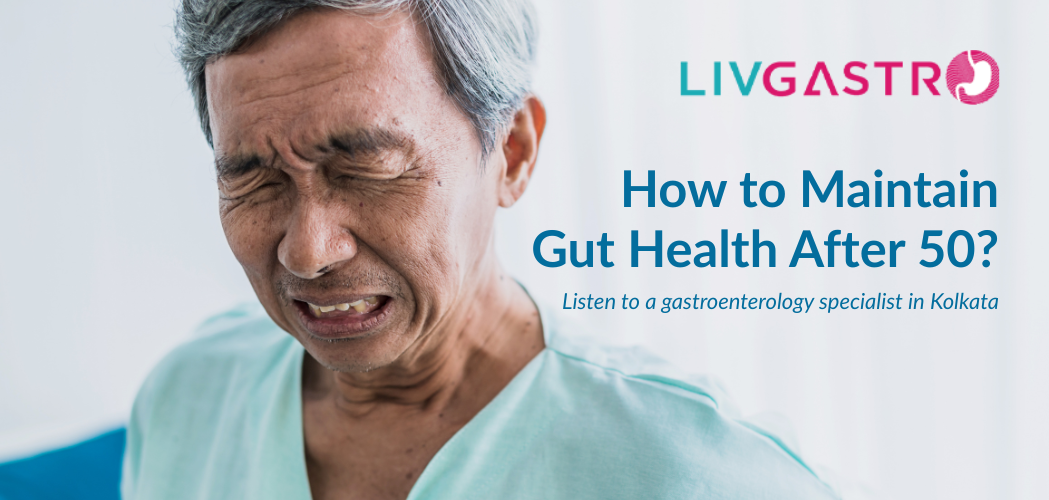
An old man above 50 suffering from problems in gastrointestinal tract

When “Minor” Symptoms Are Anything But

The “minor” levels of recurrent issues are where clinical judgement diverges most sharply from popular health advice. Here are some of the most commonly dismissed symptoms among patients over 50 and the serious conditions they can conceal.

  • Persistent Heartburn and Acid Reflux: Practically normalised, people generally choose home remedies and self-medication to suppress symptoms. Chronic, uncontrolled acid reflux can lead to serious conditions like Barrett’s Oesophagus, in some cases, oesophageal adenocarcinoma. If you have had reflux symptoms for more than three weeks, or if you notice difficulty swallowing, a sensation of food getting stuck, or worsening symptoms despite medication, such a situation warrants a formal upper GI endoscopy, not another packet of antacids.
  • Rectal Bleeding: It is extremely common for people to assume that rectal bleeding in middle-aged adults is always haemorrhoidal. It very often is. But colorectal cancer—one of the most preventable and treatable cancers, when detected early—also presents exactly this way. A 52-year-old who has been self-treating “piles” for six months and ignoring blood in the stool may, in fact, have a lesion in the colon that a timely colonoscopy would have caught at a curable stage. The only way to know with certainty is to look.
  • Changes in Bowel Habits: Narrowing of the stool calibre, alternating constipation and diarrhoea, and persistent constipation after 50 can each point to structural pathology, including colorectal cancer, thyroid dysfunction, or mechanical obstruction. Chronic laxative use in this context does not treat the cause; it delays the diagnosis.
  • Weight Loss With Digestive Symptoms: If an older adult is losing weight without trying, and the weight loss is accompanied by reduced appetite, early satiety, or persistent upper abdominal discomfort, the clinical concern is significant. Gastric cancer, pancreatic cancer, and liver disease can all present this way in early or moderate stages — often without dramatic pain. These are symptoms that cannot be attributed to “stress” or “eating less.”
  • Persistent Bloating: Bloating is often dismissed as a lifestyle issue. Often it is. But new-onset, persistent bloating in women over 50 can also be an early symptom of ovarian pathology or peritoneal disease. In either sex, bloating accompanied by a change in bowel movements, mucus in stool, or nutritional deficiency can suggest Small Intestinal Bacterial Overgrowth (SIBO), coeliac disease, or inflammatory bowel disease.

Preventive Gastroenterology: What Tests Actually Matter After 50

Preventive gastroenterology is not about running every test available. It is about the right test, at the right time, for the right patient. Here is what current evidence and American College of Gastroenterology guidelines recommend for adults in this age group:
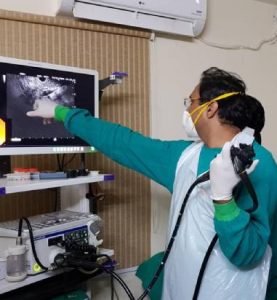
Gastroenterologist Dr. Vijay Kumar Rai

  • Colonoscopy is recommended for all average-risk individuals starting at age 45, and earlier if there is a family history of colorectal cancer or polyps. It is the gold standard for detecting polyps — which, if removed early, prevent cancer entirely — and for evaluating any lower GI symptoms. At LivGastro, colonoscopy is performed by specialists using high-definition endoscopes with meticulous bowel preparation protocols.
  • Upper GI Endoscopy (OGD Scopy) evaluates the oesophagus, stomach, and duodenum. It is indicated for persistent reflux, dyspepsia, suspected peptic ulcer disease, and weight loss. It also allows biopsy of suspicious lesions and testing for Helicobacter pylori, a bacterium strongly linked to gastric ulcer and gastric cancer.
  • H. pylori Breath Test is a non-invasive, highly accurate test to detect H. pylori infection — one of the most common and underappreciated causes of chronic gastritis and peptic ulcer disease in the Indian population.
  • Liver Function Tests and Ultrasound Abdomen are essential, particularly for those with a history of alcohol use, fatty liver disease (increasingly common with metabolic syndrome), or any hepatic symptoms. Liver disease is often asymptomatic until advanced; early detection changes outcomes dramatically.
  • Faecal Occult Blood Test (FOBT) can detect microscopic blood in the stool, offering a non-invasive screening tool between colonoscopies.

Consult the Best Gastroenterologist in Kolkata — Before a Minor Issue Becomes a Major One

If you or a family member has been experiencing persistent or unexplained digestive symptoms, we invite you to consult Dr. Vijay Kumar Rai (DM – Gastroenterology, Fellow of the American College of Gastroenterology, Fellow of the American Society of GI Endoscopy) at either of our Kolkata centres – Beleghata or Dhakuria – or reach us via telemedicine from anywhere in Bengal.

Appointments: +91 9147105221 | WhatsApp: 9369120028 Clinic hours: Monday to Saturday, 9 AM – 1 PM and 4 PM – 8 PM. Book an Appointment at livgastro.in.

FAQs


  • Is there a right age to get a colonoscopy—and is it really necessary if I have no symptoms?

Current international guidelines recommend colonoscopy screening starting at age 45 for average-risk individuals, and earlier if there is a family history of colorectal polyps or cancer. The critical point is that colorectal cancer is often entirely asymptomatic in early, highly treatable stages. Waiting for symptoms to appear before seeking a colonoscopy is clinically counterproductive. The purpose of a screening colonoscopy is precisely to act before symptoms develop.

  • I have had acidity and gastric issues for years and manage them with antacids. Do I need to see a doctor?

Yes — particularly if symptoms persist or intensify. Long-term undiagnosed reflux can be hazardous over time. Prolonged unsupervised antacid and PPI use also carries its own metabolic risks. A one-time specialist consultation can clarify whether your symptoms require investigation or simply optimised management.

  • Is there a difference between consulting a gastroenterologist and a general physician for stomach problems?

Significantly, yes. A general physician manages a broad spectrum of conditions and is best suited for initial assessment. Consulting a gastroenterology specialist in Kolkata, who is qualified with additional years of superspecialty training, helps get straight to the treatment without multiple referrals. The diagnostic workup is appropriately targeted.

  • My elderly parent has been complaining of a poor appetite, weight loss, and some bloating for two months. Is the problem just age-related?

While benign explanations exist, new-onset reduced appetite, unintentional weight loss, and abdominal bloating can be early indicators of upper GI malignancy, pancreatic pathology, or hepatic disease—conditions whose early detection makes a direct difference to treatment outcomes. Please do not attribute these symptoms to ageing without a proper specialist assessment.

  • What is the difference between a gastric problem and a liver problem — should I see a gastroenterologist for both?

The liver, bile ducts, and pancreas are all part of the hepatobiliary system, which falls squarely within the domain of gastroenterology and hepatology. Symptoms such as jaundice, pale stools, dark urine, upper right abdominal pain, persistent fatigue, or abnormal liver function tests all require the same specialist. At LivGastro, Dr. Vijay Kumar Rai manages the complete spectrum — from oesophageal disorders and peptic ulcer disease to liver cirrhosis, biliary obstruction, and pancreatic disease — ensuring that interconnected organ systems are evaluated together, not in isolation.

Related

Kidney Failure: Symptoms, Diagnosis and Treatment

Kidney Failure: Symptoms, Diagnosis and Treatment

Kidney Failure: Symptoms, Diagnosis and Treatment As reported by the Indian Express in

read more
GERD: Symptoms, Diagnosis & Treatment

GERD: Symptoms, Diagnosis & Treatment

What is GERD? GERD that stands for Gastroesophageal Reflux Disease, often called Acid R

read more
When Stomach Pain Becomes Serious: Signs You Need a Gastroenterology Specialist for a Peptic Ulcer

When Stomach Pain Becomes Serious: Signs You Need a Gastroenterology Specialist for a Peptic Ulcer

Have you ever dismissed a burning sensation in your chest or upper abdomen as simple ind

read more

NABH certification